

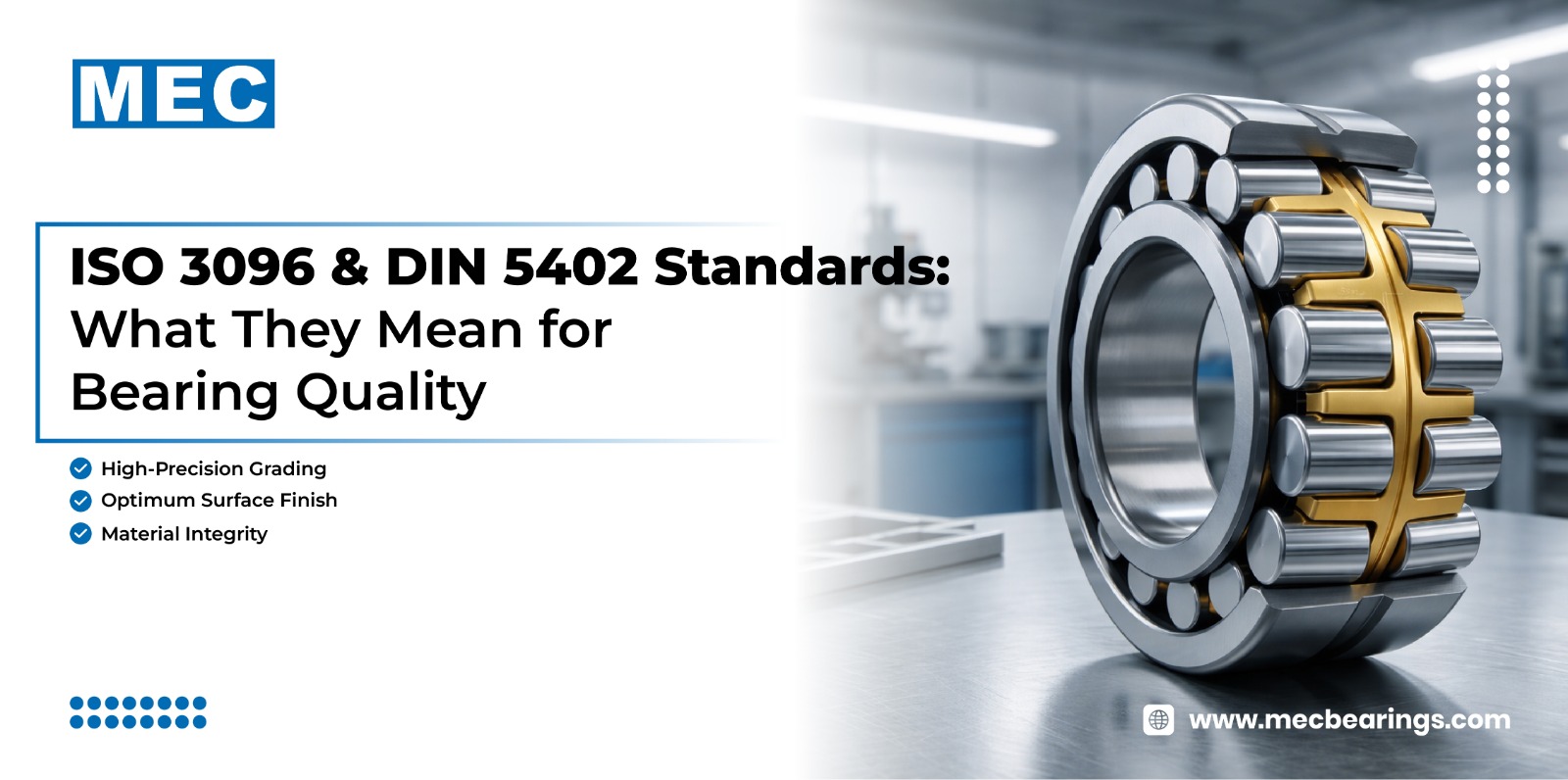
When it comes to bearing performance, the difference between a component that lasts for years and one that fails prematurely often comes down to how precisely it was made. Behind every high-quality needle roller or cylindrical roller is a set of internationally recognised standards that define what “precision” actually means. Two of the most important in the bearing industry are ISO 3096 and DIN 5402. If you work with rolling elements — whether as an OEM, a maintenance engineer, or a procurement professional — understanding these standards can help you make smarter, more informed sourcing decisions.
What Is ISO 3096? The International Benchmark for Needle Rollers
ISO 3096 is the international standard published by the International Organization for Standardization (ISO) that specifies the dimensional and geometric requirements for needle rollers used in rolling bearings. It covers key parameters such as:
- Nominal diameter and length of needle rollers
- Dimensional tolerances — how precise the roller dimensions must be
- Geometric tolerances, including straightness and roundness
- Surface roughness (Ra values) to ensure consistent contact and minimal wear
- Grade classifications that categorise rollers by their level of precision
In simple terms, ISO 3096 sets the global language for what a needle roller should look like, how it should behave dimensionally, and what surface quality it must achieve. This ensures that rollers from different manufacturers can be used interchangeably in standardised bearing assemblies without compromising performance.
What Is DIN 5402? The German Engineering Standard That Shaped the Industry
DIN 5402 is the German Institute for Standardization (Deutsches Institut für Normung) standard that governs rolling bearing components — specifically, the dimensional and tolerance specifications for cylindrical rollers and needle rollers. Originating in Germany, DIN standards have long been considered some of the most rigorous engineering benchmarks in the world, and DIN 5402 is no exception.
DIN 5402 closely aligns with ISO 3096 but may include additional specifications relevant to European engineering practices. It defines:
- Dimensional tolerances for roller diameter and effective roller length
- Convexity profiles — the subtle crown geometry on rollers that reduces edge stress
- Surface quality requirements to prevent premature fatigue
- Hardness and material requirements in conjunction with material standards
For manufacturers and buyers operating in European markets or supplying global OEMs, DIN 5402 compliance is frequently a non-negotiable requirement.
Why Do ISO 3096 and DIN 5402 Matter for Bearing Quality?
A rolling bearing is only as good as its rolling elements. Even the most well-designed bearing assembly will underperform — or fail outright — if the rollers inside it deviate from the required dimensions or surface quality. Here is why these standards are so critical:
1. Dimensional Accuracy — The Foundation of Bearing Performance
Both ISO 3096 and DIN 5402 specify tight tolerances on roller diameter and length. For needle rollers, these tolerances can be in the range of just a few micrometres. Consistent dimensional accuracy means every roller in a batch behaves the same way, distributes load evenly, and reduces internal bearing stresses.
2. Surface Roughness — Friction, Wear, and Fatigue Life
Surface finish is not just an aesthetic concern. The Ra (arithmetic mean roughness) values defined in ISO 3096 directly influence the formation of lubricant film, the friction coefficient, and ultimately the fatigue life of the bearing. A surface that is too rough increases contact stress; one that is too smooth can impair lubricant adhesion. Getting this right is an art as much as a science.
3. Geometric Tolerances — Roundness, Straightness, and Convexity
A roller that is not perfectly round or straight will create uneven load distribution across the bearing raceway. Over time, this leads to raceway damage, vibration, noise, and early bearing failure. DIN 5402’s convexity specifications ensure that rollers have a slight, controlled crown that prevents stress concentration at the roller ends — a common cause of premature fatigue.
4. Interchangeability — Global Supply Chain Confidence
When rollers meet ISO 3096 and DIN 5402 specifications, they can be sourced from different manufacturers and used in standard bearing designs without redesign or re-validation. This gives OEMs and buyers supply chain flexibility and confidence — especially important in sectors like automotive, aerospace, and industrial machinery.
How MEC Bearings Private Limited Applies These Standards
Since its establishment in 1988, MEC Bearings Private Limited has built its entire manufacturing philosophy around precision and standards compliance. MEC produces a wide range of rolling elements — including needle rollers, cylindrical rollers, and cylindrical pins — strictly according to DIN 5402 and ISO 3096 standards.
The rolling elements manufactured at MEC are available in two primary material grades:
- Bearing Steel: SAE 52100 / 100Cr6 / SUJ2 — the industry-standard high-carbon chromium steel offering excellent hardness, wear resistance, and fatigue life
- Stainless Steel: AISI 302 / 304 / 316 — for applications demanding corrosion resistance, such as food processing, medical, and marine environments
This compliance is not just a certificate on the wall. At MEC, standards adherence is built into every stage of the manufacturing process — from raw material selection and heat treatment to precision grinding, lapping, and final inspection. The company holds IATF 16949:2016 and ISO 14001:2015 certifications, underscoring its commitment to automotive-grade quality and responsible manufacturing. This makes MEC a trusted partner for major OEMs in both the Indian and international markets, as well as a strong player in the aftermarket segment.
What to Look for When Sourcing Standard-Compliant Rolling Elements
Not all suppliers who claim compliance actually deliver it consistently. When evaluating a source for needle rollers or cylindrical rollers, consider the following:
- Documented QMS certification (IATF 16949 for automotive-grade, ISO 9001 for general industrial)
- In-house metrology and inspection capabilities — CMM machines, surface profilometers, roundness testers
- Traceability of raw materials to verified steel grades (SAE 52100, 100Cr6, etc.)
- Consistent lot-to-lot quality, not just sample compliance
- Ability to supply across a wide size range with the same quality standards
A manufacturer who meets ISO 3096 and DIN 5402 consistently — not just occasionally — is one who has invested in the right equipment, processes, and culture of quality.
Conclusion:
ISO 3096 and DIN 5402 are more than just technical documents. They represent the collective engineering wisdom of the bearing industry, translated into measurable, enforceable quality requirements. For anyone specifying or sourcing rolling elements, these standards are the clearest indicator of whether a supplier is truly capable of delivering precision-grade components.
When you source rollers that meet these standards, you are investing in bearing longevity, system reliability, and reduced downtime — all of which add up to real savings over time. As a manufacturer that has built its reputation on standard compliance since 1988, MEC Bearings understands that quality is not a destination — it is an ongoing commitment baked into every roller we produce.
Ready to Source Precision Rolling Elements That Meet ISO 3096 & DIN 5402?
At MEC Bearings Private Limited, we manufacture needle rollers, cylindrical rollers, and cylindrical pins to the highest international standards — available in bearing steel and stainless steel grades to suit your application. Whether you are an OEM, a distributor, or an aftermarket buyer, we have the precision, capacity, and consistency you need.