


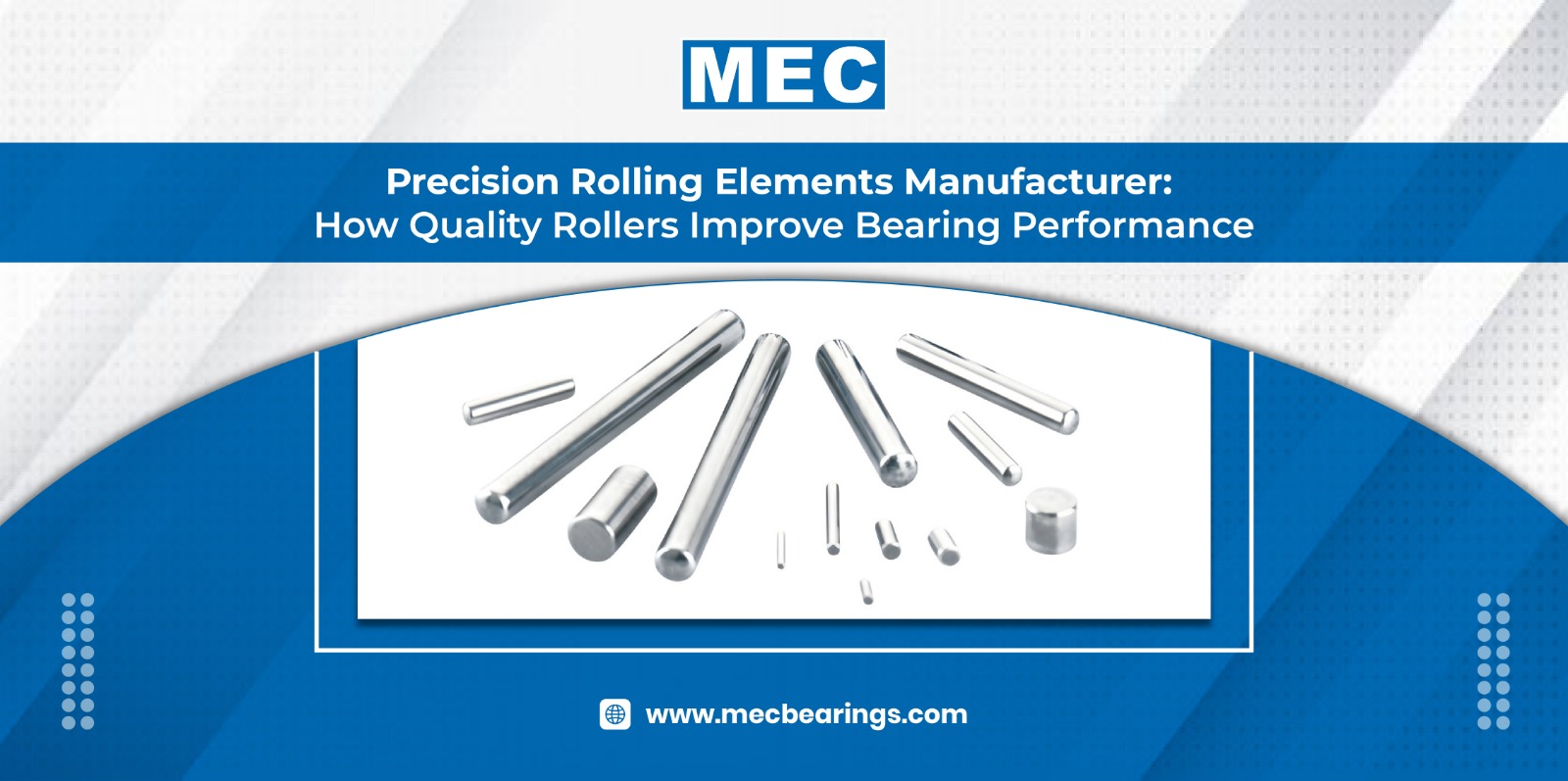
When a machine fails, the root cause is often hiding in plain sight — inside the bearing. And at the heart of every high-performing bearing are rolling elements that most people never think about. As a trusted precision rolling elements manufacturer, we’ve seen firsthand how the quality of a roller can determine whether a machine runs smoothly for years or breaks down within months.
This blog explores how precision-engineered rolling elements directly influence bearing performance, and why working with the right manufacturer makes all the difference.
What Is a Precision Rolling Elements Manufacturer — and Why Does It Matter?
A precision rolling elements manufacturer is not just a parts supplier — it’s a partner in engineering reliability. Rolling elements, including cylindrical rollers, tapered rollers, spherical rollers, and needle rollers, are the core components inside bearings that enable smooth rotational motion under load.
At our facility, we manufacture rolling elements to micron-level tolerances, using stringent quality controls at every step of the production process. The precision of these components directly dictates how a bearing performs, how long it lasts, and how much energy it consumes during operation.
Whether you’re working in the automotive, aerospace, heavy machinery, or industrial automation sector, choosing a manufacturer who truly understands precision is non-negotiable.
How Quality Rollers Improve Bearing Performance
The connection between quality rollers and bearing performance is deeply technical — but the impact is easy to understand. Here’s what precision-manufactured rolling elements actually do for your bearings:
1. Reduce Friction and Heat Generation
Rolling elements that are dimensionally consistent and surface-finished to tight tolerances generate significantly less friction. Less friction means lower operating temperatures, which in turn extends bearing life and reduces the risk of lubrication breakdown.
2. Enhance Load Distribution
Precision rollers ensure that radial and axial loads are distributed evenly across the raceways. Inconsistent roller geometry — even by a few microns — can create stress concentrations that accelerate fatigue and lead to premature failure.
3. Minimize Vibration and Noise
High-quality rolling elements contribute to quieter and smoother bearing operation. For applications in precision instruments, medical devices, or high-speed machine tools, vibration control isn’t just a performance metric — it’s a safety and quality standard.
4. Extend Bearing Service Life
Everything above adds up to one critical outcome: longer service life. A precision-manufactured rolling element can double or even triple the operational lifespan of a bearing compared to a substandard equivalent.
Material and Surface Quality: The Foundation of Rolling Element Precision
Quality begins long before machining. The choice of raw material plays a crucial role in how rolling elements perform under real-world conditions.
We use high-grade bearing steels — including through-hardened and case-hardened variants — selected based on the specific application requirements. Each batch is tested for hardness, metallurgical composition, and internal cleanliness before production begins.
Surface finish is equally critical. Our rolling elements undergo multi-stage grinding and superfinishing processes to achieve the smoothness and roundness specifications required for high-performance bearings. Even the slightest deviation in surface roughness can disrupt the lubricant film, leading to metal-to-metal contact and accelerated wear.
As a precision rolling elements manufacturer, we treat material and surface quality not as afterthoughts but as the foundation of everything we deliver.
Why Industries Trust a Reliable Precision Rolling Elements Manufacturer
Industries that depend on continuous, high-load operation — think steel mills, wind turbines, railway systems, and construction equipment — simply cannot afford bearing failures. The downtime costs alone can run into thousands of dollars per hour.
That’s why procurement teams and design engineers increasingly prioritize sourcing rolling elements from manufacturers who can consistently deliver:
- Tighter dimensional tolerances (Grade 10 to Grade 3 per ISO standards)
- Certified material traceability and heat treatment documentation
- Custom roller geometries for specialized bearing designs
- Batch-level inspection reports and quality certifications
- On-time delivery for both standard and custom orders
Our team works closely with clients to understand their specific load profiles, operating environments, and OEM requirements — and then engineers rolling elements that meet those demands precisely.
Custom Rolling Elements: When Standard Isn’t Enough
Many high-performance applications require rolling elements that go beyond standard catalog specifications. Whether it’s a non-standard roller diameter, a special crown profile, or a unique end geometry, off-the-shelf products often fall short.
As an experienced precision rolling elements manufacturer, we offer full custom development services — from design consultation and prototyping to volume production. Our engineering team collaborates directly with clients to develop rolling element solutions that optimize bearing performance for their specific application, whether it’s high-speed spindles, oscillating motion bearings, or extreme temperature environments.
Conclusion:
At the end of the day, the performance of any bearing is only as good as the rolling elements inside it. Subpar rollers lead to premature failures, costly downtime, and frustrated engineering teams. Precision-manufactured rolling elements, on the other hand, deliver measurable improvements in friction, load capacity, noise, and service life.
Choosing the right precision rolling elements manufacturer is one of the most impactful decisions a bearing designer or procurement professional can make. It’s not just about getting a part — it’s about building reliability into every rotation, every load cycle, and every application you serve.
We believe that quality rollers don’t just improve bearing performance — they protect your machinery, your reputation, and your bottom line.